
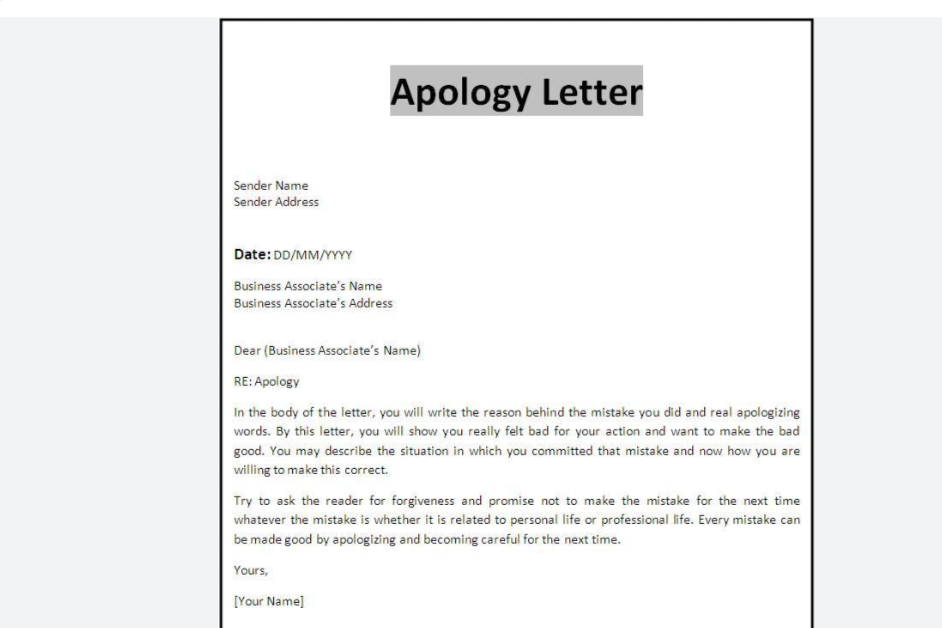
Everyone slips up at work. Missed deadline? Wrong email? Harsh words in a meeting? Saying sorry the right way can fix more than the error — it can restore trust. This guide teaches you how to write a short, honest workplace apology letter that sounds real, shows responsibility, and helps move things forward.
What Is a Workplace Apology Letter?
A workplace apology letter is a short written message where you:
- Admit a mistake,
- Say you’re sorry,
- Explain what you’ll do to fix it, and
- Promise to avoid the same error again.
It can be an email or a printed note. The goal is to be clear, calm, and constructive.
When You Should Write One
Write a workplace apology letter when your mistake:
- Affected your team’s work or deadlines,
- Caused a client problem,
- Was rude or unprofessional,
- Created confusion or loss of trust,
- Or when a manager asks for a written apology.
If it’s small (a tiny typo that causes no harm), a quick in-person apology may be enough.
Simple Structure — Follow This Order
Use this clear structure to keep your message honest and useful:
Subject line (for email)
- Make it direct: “Apology for Missing Deadline — [Your Name]”
Greeting
- Keep it respectful: “Hi [Name],” or “Dear [Manager’s Name],”
Opening apology (first sentence)
- Say you’re sorry right away: “I want to apologize for…”
Take responsibility (no excuses)
- Use “I” statements: “I take full responsibility…”
Brief explanation (not a defense)
- One sentence to explain context, not to blame.
Fix and prevention
- Describe what you did to fix it and what you’ll change to stop it happening again.
Short Example Template (Email)
Subject: Apology for Missing the [Project] Deadline — [Your Name]
Hi [Name],
I want to sincerely apologize for missing the [project/report] deadline on [date]. I take full responsibility for this oversight.
I misjudged the time needed because I was also handling [brief reason — keep it short]. That’s not an excuse. I have completed the [deliverable] and attached it to this email. Going forward, I will use a scheduling tool and set earlier internal deadlines to make sure this does not happen again.
Thank you for your understanding. I appreciate the chance to correct this.
Sincerely,
[Your Name]
Sample: Apology to a Coworker After a Heated Meeting
Subject: Sorry for My Comments Today
Hi [Coworker’s Name],
I’m sorry for the way I spoke during today’s meeting. I realize my words were sharper than they should have been, and I regret how that made you feel. I take full responsibility.
I was frustrated by the project delays, but that does not justify my tone. I’ll speak with you privately to clear up any issues and will be more careful with my language in future meetings.
Thanks for hearing me out.
Best,
[Your Name]
Sample: Apology to a Client for an Error
Subject: Apology for the Billing Error — [Company/Your Name]
Dear [Client Name],
I want to apologize for the billing error on your invoice dated [date]. This mistake was our fault, and I understand the inconvenience it caused.
We have corrected the invoice and issued a refund/credit. To prevent this, we’ve updated our billing checklist and added a second review step before invoices are sent.
Please let me know if there’s anything else I can do to make this right.
Regards,
[Your Name]
[Position] | [Company]
Clear Dos and Don’ts
Do:
- Apologize quickly and clearly.
- Use “I” and accept responsibility.
- Offer a fix and explain how you’ll avoid repeating it.
- Keep it short — 4–6 short paragraphs is fine.
- Be professional and sincere.
Don’t:
- Blame others or make long excuses.
- Be vague about what went wrong.
- Over-apologize with repetitive “I’m so sorry” lines.
- Hide corrective steps — saying nothing about fixes looks flimsy.
- Use sarcastic or defensive language.
Why This Format Works (Plain Explanation)
Apologies in this style work because they:
- Show empathy and maturity,
- Give the other person confidence you’ll change,
- Keep records of what happened and how it was fixed,
- Help you stay professional and calm in future conversations.
Think of an apology like a repair order: admit the damage, fix it, and add protection so it doesn’t break again.
Short Templates for Different Situations
Missed deadline (short)
Subject: Apology for Missing Deadline — [Your Name]
Hi [Name],
I apologize for missing the deadline on [date]. I take full responsibility. I’ve completed the work and attached it. I’ll use progress check-ins to avoid this in future. Thank you for your patience. — [Your Name]
Wrong email sent (short)
Subject: Apology for Sending Incorrect Email
Hi [Name],
I’m sorry I sent the wrong email earlier. I’ve corrected and resent the right version. I’ll double-check recipients going forward. — [Your Name]
Unprofessional behavior (short)
Subject: Apology for My Behavior
Hi [Name],
I’m sorry for my behavior on [date]. I understand it was inappropriate. I will work on staying professional in stressful situations. — [Your Name]
FAQs — Quick Answers People Ask
Q: Should I apologize in person or by email?
A: For serious matters, apologize in person or by video call first, then follow up with a short written apology. For smaller issues, a clear email is fine.
Q: How long should the apology be?
A: Keep it short — usually 4–6 short paragraphs or under 200–300 words.
Q: Is it okay to mention reasons?
A: Yes, briefly. Give context but avoid sounding like you’re making excuses.
Q: What if my manager wants a formal apology?
A: Use a formal tone, follow the structure above, and add any official corrective actions your company requires.
Extra Tips to Sound Genuine
- Use the person’s name.
- Avoid corporate jargon — keep it human.
- Look for a small way to make up for the mistake (fix, resend, reimburse).
- Check grammar and tone before sending. A sloppy apology can make things worse.
- Keep records of your email or note in case HR asks later.
Real-World Example (Before and After)
Before: “Sorry I messed up the report. My bad.”
After: “Hi Sarah — I apologize for the errors in the April report. I take full responsibility. I’ve updated the report and attached the corrected version. I will add a second review step before submission so this won’t happen again. Thank you for your patience. — Ahmed”
Closing — How to End Strong
Always end your apology with a short reassurance and a polite sign-off. This shows you respect the person and want to move forward.
Action Plan (What to Do Right Now)
- Pick the right channel: in-person for big issues, email for most others.
- Follow the template above. Write the apology, then step away for 10 minutes.
- Re-read it as if you were the recipient. Remove excuses. Keep the fix clear.
- Send it. Then follow up with actions you promised
- A well-written workplace apology letter shows responsibility and respect. When you say sorry clearly and show how you’ll fix things, you rebuild trust fast — and that’s what strong teams are built on.
