
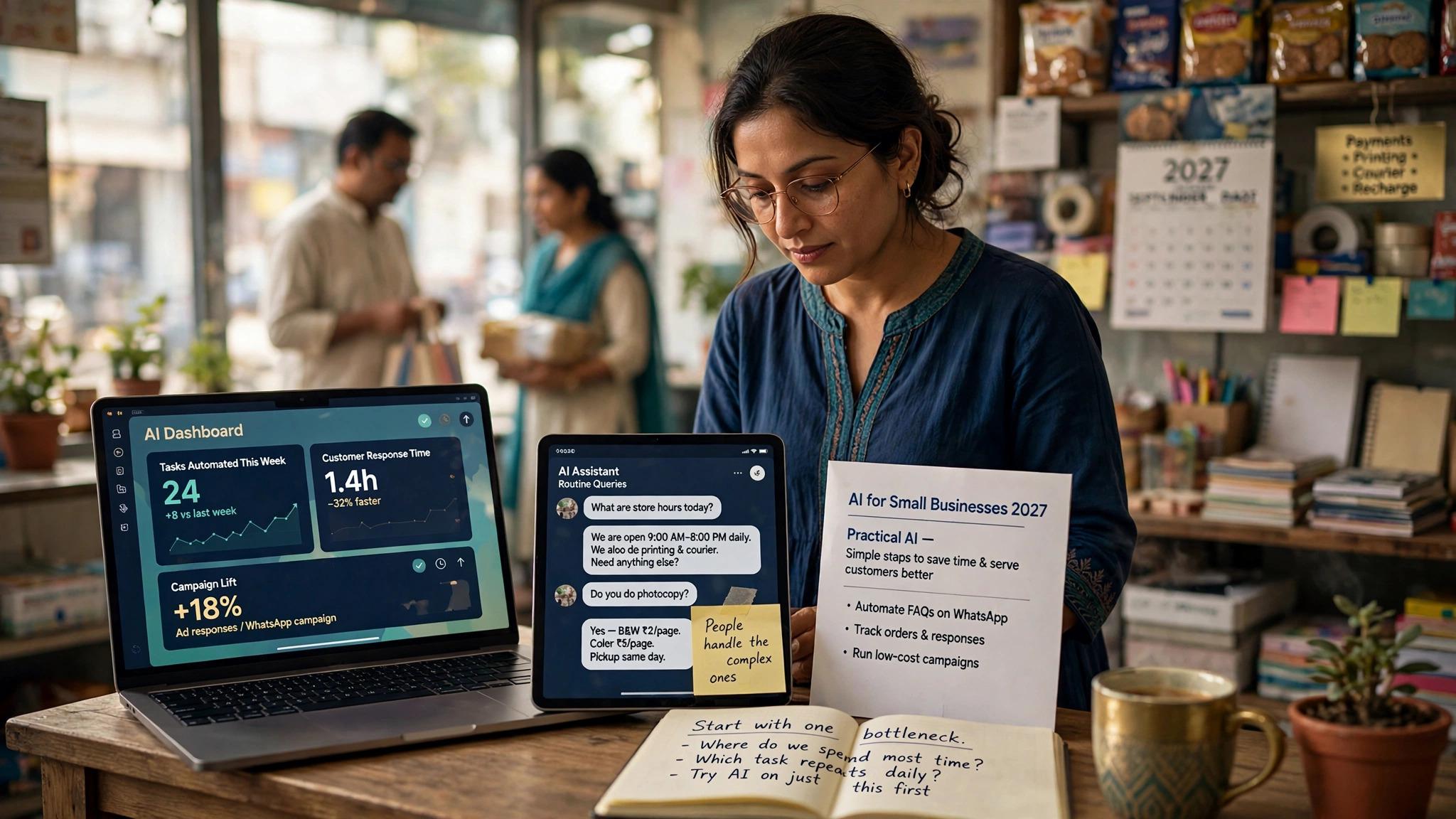
Introduction: AI Is Changing the Small-Business Competitive Landscape
AI for small businesses is no longer a nice-to-have experiment — it’s quickly becoming the thing that decides who competes and who gets left behind. Large companies have traditionally had a built-in edge in technology, data, and sheer staffing capacity. A small business owner running a five-person shop simply couldn’t match a national competitor’s marketing team, customer service department, or analytics budget. AI is chipping away at that gap, fast. Tasks that used to require a dedicated employee, an outside agency, or expensive enterprise software are now within reach of a business with a laptop and the right AI tools.
That’s really the shift worth paying attention to heading into 2027. The real question for small businesses isn’t whether they’ll use AI — most already are, in some form. It’s how strategically they use it. Understanding how small businesses can use AI to compete, rather than adopting tools randomly because everyone else seems to be, is what separates owners who get genuine leverage from those who end up with a stack of subscriptions nobody actually uses. Here are seven practical, grounded ways small businesses are putting AI to work in 2027.
1. Automate Repetitive Business Tasks
Data entry, scheduling, email management, document processing, reporting, and basic administrative work eat up hours every week that most small-business owners would rather spend on customers or growth. AI business automation tools can now handle a meaningful chunk of this — sorting and drafting email responses, auto-filling routine paperwork, generating weekly reports from existing data, and managing scheduling without back-and-forth emails.
The key takeaway here matters more than the tools themselves: small businesses don’t necessarily need to hire someone new for every task that comes up. The smarter first move is figuring out how small businesses can automate repetitive tasks with AI before assuming the solution is another salary. A task that eats five hours a week manually might take an AI tool fifteen minutes to handle, freeing that time for work that actually grows the business.
2. Use AI to Build More Effective Marketing Campaigns
AI marketing for small businesses covers a lot of ground now — customer segmentation, content ideas, email marketing sequences, social media planning, ad optimization, and campaign performance analysis, all of which used to require either a marketing hire or an agency retainer.
The practical angle worth remembering is that AI should assist with marketing strategy, not just pump out generic content in bulk. A small business that uses AI to sharpen its targeting and personalize its messaging will outperform one that just uses AI to publish more posts. Owners exploring how small businesses can use AI for marketing get the best results when they treat these tools as a strategist’s assistant, not a replacement for actually understanding their customer.
3. Improve Customer Service With AI
AI customer service tools — chat assistants, automated FAQs, basic 24/7 support, lead qualification, and appointment scheduling — let small businesses respond to customers far faster than a single owner or small team could manage manually. AI can also analyze customer feedback at scale, surfacing patterns a business owner might otherwise miss buried in scattered reviews and support tickets.
The important point here is balance. Use AI for routine, repetitive questions — order status, business hours, basic troubleshooting — while keeping real employees available for complex or sensitive issues that actually need a human touch. Businesses looking at how AI can improve customer service for small businesses tend to see the best results when AI handles volume and people handle nuance, rather than trying to automate the entire customer relationship.
4. Make Better Business Decisions With AI
AI can help small-business owners analyze sales data, customer behavior, inventory levels, marketing performance, revenue trends, cash-flow patterns, and demand forecasts — data that used to require a dedicated analyst or hours of manual spreadsheet work to interpret.
The core message worth holding onto: AI doesn’t replace the owner’s judgment. It gives the owner better information to make that judgment call with. A small-business owner still knows their customers and their market better than any algorithm — AI just removes a lot of the guesswork about what the actual numbers are saying, which is central to how AI can help small businesses grow without expanding overhead every time the business needs better insight.
5. Give Small Teams More Productivity
AI productivity tools are helping small teams handle research, writing, meeting summaries, presentations, data analysis, customer follow-ups, and internal documentation faster than before — work that used to eat into hours better spent on higher-value tasks.
The business angle here is straightforward: a five-person company can potentially operate more efficiently without immediately expanding its headcount. For owners looking at ways small businesses can use AI to save time, productivity gains in these everyday, unglamorous tasks often add up to more real time saved than any single flashy AI feature.
6. Compete With Larger Companies Through Better Customer Experiences
This is arguably the strongest competitive-advantage angle for small businesses. AI lets smaller companies deliver faster responses, more personalized recommendations, better follow-ups, more relevant marketing, quicker service, and more consistent communication — the exact areas where large companies, despite their resources, often move slowly because of internal bureaucracy.
The main argument worth internalizing: AI can help smaller companies compete on speed, personalization, and responsiveness, even when they genuinely can’t compete on budget or workforce size. Understanding how AI can help small businesses compete with larger companies often comes down to this — a big company might have more resources, but a small business with the right AI tools can often respond to a customer faster and more personally than a call center ever will.
7. Build an AI-Ready Business Strategy for 2027
Rather than adopting every new AI tool that launches, small businesses get far better results from a focused approach: identify the biggest operational bottleneck, choose one AI use case to address it, test it on a small scale, measure the actual time or cost savings, monitor output quality, train employees properly, and only then expand to other applications.
This structured approach is exactly what separates the best AI strategies for small businesses from a scattered pile of underused subscriptions. Trying to automate everything at once usually means nothing gets automated well — a focused pilot that proves real value is a far stronger foundation than a dozen half-adopted tools.
The Risks Small Businesses Should Consider Before Adopting AI
AI adoption isn’t without genuine risk, and a balanced approach means taking these seriously rather than rushing past them:
- Data privacy — Customer information fed into AI tools needs clear handling policies, especially with third-party platforms.
- Incorrect AI-generated information — AI can produce confident-sounding but wrong answers, which is a real risk in customer-facing content or support.
- Over-automation — Too much automation can make a small business feel impersonal, undermining the very relationship-driven advantage small businesses usually have.
- Security — AI tools connected to business systems widen the potential attack surface if not properly secured.
- Employee training — Staff need real training to use AI tools effectively and to know when to escalate to a human decision.
- Customer trust — Being transparent about where AI is being used (e.g., a chatbot vs. a real person) tends to preserve trust better than pretending otherwise.
- Dependence on third-party AI platforms — Relying heavily on one AI vendor carries risk if pricing, features, or availability change unexpectedly.
Why AI Could Be a Competitive Equalizer for Small Businesses
Historically, technology advantages have favored large companies with the budgets to build custom systems and hire specialized staff. AI is shifting that dynamic meaningfully — sophisticated tools that once required an enterprise IT budget are now accessible to a business with a handful of employees and a modest monthly subscription.
But here’s the nuance that matters for understanding how small businesses can use artificial intelligence to compete effectively: the competitive advantage won’t come from simply owning AI tools, since most competitors will have access to similar technology before long. It will come from integrating AI into daily workflows better and more thoughtfully than competitors do — genuinely solving operational problems rather than adopting tools for their own sake.
Staying Ahead of the Business Trends Shaping 2027
Small-business owners also need to stay informed about changes in technology, markets, startups, and the broader business environment to make good decisions about where AI actually fits into their operations. Following business publications such as Malik Times can help entrepreneurs keep track of emerging trends and developments that may affect their growth strategies, from shifts in AI adoption across industries to broader economic signals worth watching.
Conclusion: Small Businesses Don’t Need to Become AI Companies
AI adoption should solve actual business problems, not become a goal in itself. The small businesses getting real value from AI in 2027 are starting with simple, measurable use cases, resisting the urge to automate everything at once, and keeping human judgment firmly at the center of decisions that actually matter to customers. Done this way, AI for small businesses isn’t about becoming a tech company — it’s about using accessible tools to improve efficiency, sharpen the customer experience, and compete on speed and personalization in ways that used to require a much bigger budget.
Frequently Asked Questions (FAQs)
1. How can small businesses use AI to compete with larger companies? Small businesses can use AI to deliver faster, more personalized customer experiences — quicker responses, tailored recommendations, and consistent communication — areas where large companies often move slower due to internal complexity, despite having more resources overall.
2. What are the best AI tools for small businesses in 2027? The most useful tools tend to address a specific bottleneck: automation tools for repetitive admin work, AI-powered customer service chat assistants, and marketing tools for segmentation and campaign optimization. The “best” tool depends entirely on which task is costing the business the most time.
3. Is AI expensive for small businesses to adopt? Not necessarily. Many AI tools are available on affordable monthly subscriptions, and starting with one focused use case — rather than a full technology overhaul — keeps costs manageable while still delivering measurable time or cost savings.
4. Can AI replace employees in a small business? AI is better suited to handling repetitive, high-volume tasks than replacing employees outright. Most small businesses see the best results using AI to free up employee time for higher-value work, while keeping people involved in complex or sensitive customer interactions.
5. How can small businesses use AI for marketing without sounding generic? AI works best as a marketing strategist’s assistant — helping with segmentation, campaign analysis, and personalization — rather than simply generating bulk content. Pairing AI output with genuine brand voice and human review keeps marketing from feeling templated.
6. What are the risks of using AI in a small business? Key risks include data privacy concerns, inaccurate AI-generated information, over-automation that feels impersonal, security exposure, and dependence on third-party platforms. Clear policies and human oversight help manage these risks.
7. How does AI improve customer service for small businesses? AI chat assistants and automated FAQs can handle routine questions instantly and around the clock, while human staff stay focused on complex or sensitive issues — improving response speed without sacrificing quality on the interactions that matter most.
8. What’s the best way for a small business to start using AI? Identify the single biggest operational bottleneck, pick one AI use case to address it, test it on a small scale, and measure the actual time or cost savings before expanding to additional applications. This avoids wasted spend on tools that don’t get properly used.
9. Can AI really help small businesses grow, or is it mostly hype? AI can genuinely support growth when used to improve decision-making, marketing efficiency, and customer experience — but the value comes from strategic, focused adoption, not from owning the most tools. Businesses that integrate AI thoughtfully tend to see the clearest gains.
10. How is AI leveling the playing field between small and large businesses? AI is making sophisticated capabilities — data analysis, personalized marketing, fast customer support — accessible to businesses without an enterprise budget. The real competitive edge now comes from how well a business integrates AI into its workflows, not simply from having access to the technology.
