
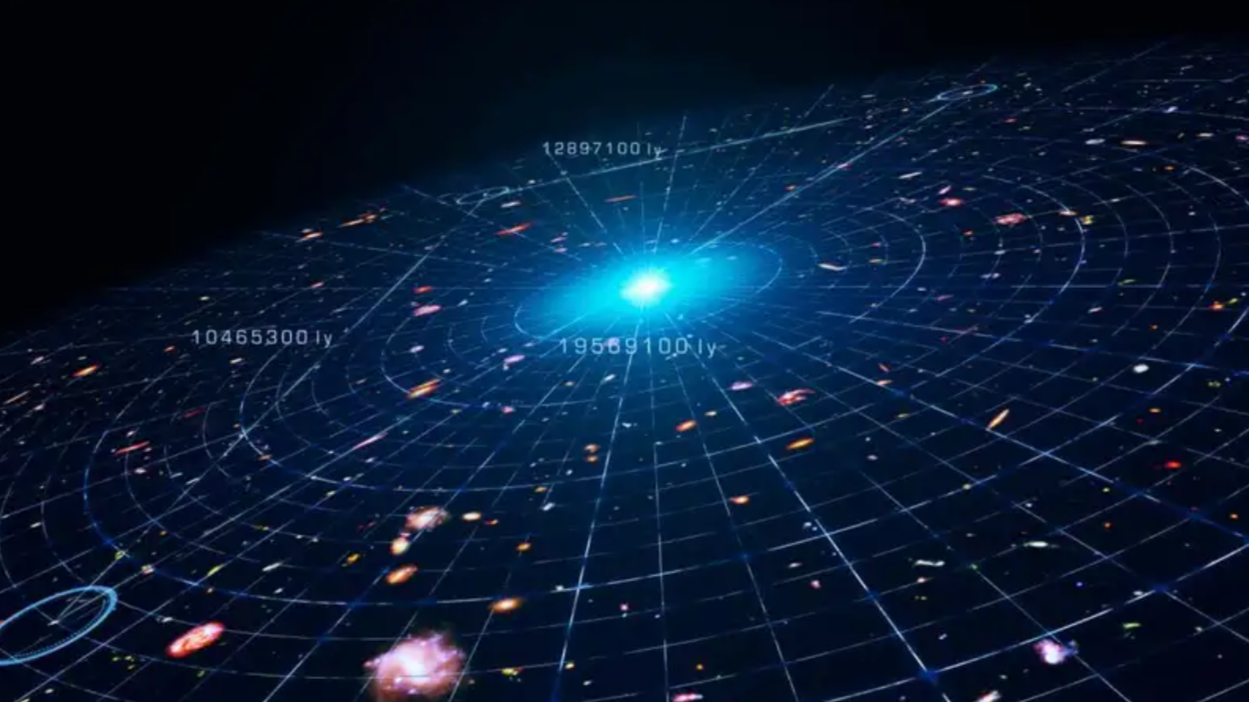
Imagine painting dots on a balloon. As the balloon inflates, the dots move away from each other. That’s how our universe is growing. But how fast is it expanding? This big question still puzzles scientists. Let’s explore what they know and why they don’t quite agree yet.
What Is the Universe’s Expansion?
- In 1929, astronomer Edwin Hubble found that farther galaxies move away faster. This rule, called Hubble’s Law, means space itself is stretching, not galaxies racing through space.
- The rate of expansion is called the Hubble constant (H₀), usually measured in kilometers per second per megaparsec (km/s/Mpc). One megaparsec = about 3.26 million light-years.
Different Ways to Measure It and the Big Disagreement
Scientists have two main ways to measure how fast the universe expands:
1. Early-Universe Method (CMB Way)
- Uses the cosmic microwave background (CMB)—the faint afterglow from the Big Bang.
- The Planck satellite and similar tools say H₀ is roughly 67 km/s/Mpc.
2. Local Measurement (Supernovae & Stars)
- Measures nearby stars like Cepheid variables and supernovae as “standard candles.”
- This method puts H₀ at around 72–74 km/s/Mpc.
This mismatch is called the Hubble tension—a famous cosmic mystery.
What Does the James Webb Telescope Say?
The James Webb Space Telescope added fresh data. It supports the higher local value about 73 km/s/Mpc making the disagreement even stronger.
Could We Live in a Cosmic Bubble?
Here’s a wild idea: maybe our part of the universe is in a giant cosmic void—a lower-density region. If true, nearby space could appear to expand faster, even if the cosmic average is slower. That could explain the Hubble tension without needing brand-new physics.
Is the Expansion Speeding Up or Slowing Down?
- In the late 1990s, scientists found the universe’s expansion is accelerating, not slowing—thanks to observations of distant supernovae. Early measurements expected gravity to slow everything.
- The force causing this acceleration is called dark energy, and it makes up about 68–70% of the universe.
- New results from the DESI project suggest dark energy might be weakening over the past 4–5 billion years hinting it’s not constant. That could reshape the universe’s fate.
Why It Matters
Getting the Hubble constant right helps us answer big questions:
- How old is the universe?
- How much dark energy or dark matter is out there?
- Will the universe expand forever or someday collapse?
Disagreement between measurements means our cosmic map may need updating.
A Quick Analogy: Measuring Growth
Think of measuring a tree’s growth:
- One person measures the new rings, telling how fast it grew recently.
- Another studies the core pattern under the bark to estimate overall growth history.
- If both numbers differ, maybe the tree had irregular growth or we’re using the wrong tools—just like cosmologists.
Frequently Asked Questions (FAQs)
Q: What exactly is the Hubble constant?
A: It’s the speed space expands measured as km/s per million parsecs of distance.
Q: Why are there two different measurements?
A: One uses early-universe echoes (CMB), the other uses nearby stars and supernovae.
Q: Could dark energy explain it?
A: Yes some think dark energy changes over time, which would affect expansion.
Q: Is it really a problem?
A: Yes it’s one of the biggest puzzles in cosmology right now.
Q: Could we be in a cosmic void?
A: Possibly. A large under-dense region around us might distort local measurements.
Q: What tools could help resolve it?
A: More powerful telescopes and sky surveys like DESI, Roman Space Telescope, and Vera Rubin Observatory.
So, how fast is the universe expanding? We don’t know exactly but we know it’s speeding up. Two trusted methods give different answers. Telescopes like Webb and studies of cosmic voids may help us solve the mystery. For now, the universe keeps growing and keeping scientists curious too.
