
Rising medical expenses can easily disrupt even the best financial plans. That is why having health insurance is no longer optional; it is essential. Beyond providing medical protection, it also helps you save on income tax every year.
Health insurance plans vary widely in how they treat the Section 80D benefit, and understanding those differences before purchasing can help you structure your insurance buying in a more tax-efficient way. Some health insurance plans allow you to claim the preventive health check-up deduction of up to ₹5,000 within the overall 80D limit, while others process it separately. The premium payment frequency also matters: annual lump-sum payments are the most straightforward for 80D documentation, but many health insurance plans now allow quarterly instalments — and as long as the premium is paid through a non-cash mode, the deduction applies proportionally regardless of the payment schedule. Comparing health insurance plans with an eye on the 80D-optimised total outlay — your premium cost minus the effective tax saving at your slab rate — gives you a clearer picture of the real annual cost of coverage than looking at the premium in isolation.
Yes, Section 80D of the Income Tax Act lets you save money while protecting your family’s health. Let us understand how this health insurance tax section works, who can benefit from it, and how much deduction one can claim.
The Health Insurance Tax Section: Section 80D
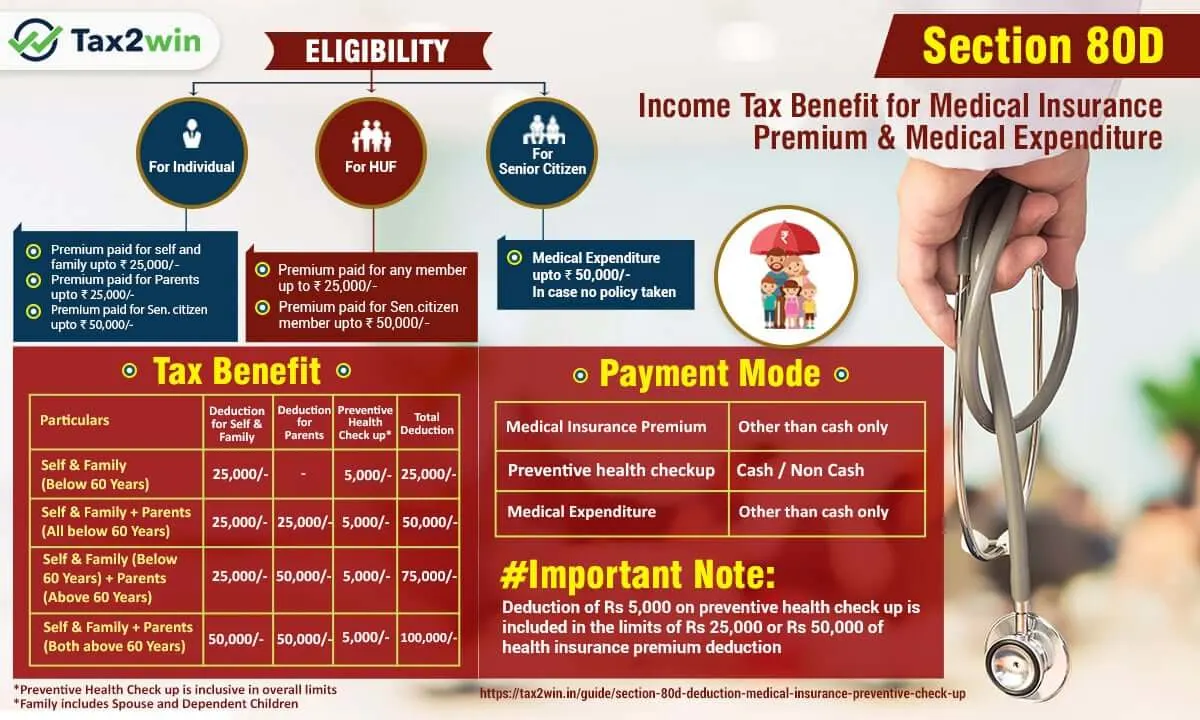
Under Section 80D, individuals and Hindu Undivided Families (HUFs) can claim a deduction for the health insurance premiums they pay for themselves, their spouse, dependent children, and health insurance for parents. This health insurance tax benefit is available regardless of whether the insurance policy is taken from a public or private insurance company, as long as it is registered with IRDAI.
Tax Deduction Limits Under Section 80D
The deductions under Section 80D vary depending on the age of the insured and the relationship of the policyholder with the insured members. You can also claim an additional deduction of up to ₹5,000 for preventive health check-ups (included within the overall ₹25,000 or ₹50,000 limit). For instance, if you are 35 years old and pay ₹22,000 as a premium for your family and ₹40,000 for your senior citizen parents, you can claim a total deduction of ₹65,000.
The higher limit available for senior citizen parents — ₹50,000 against the standard ₹25,000 — reflects the practical reality of health insurance for parents. Premiums for a couple in their mid-to-late 60s routinely run significantly higher than what younger members pay, and the coverage profile shifts too: longer hospital stays, more frequent diagnostic tests, chronic condition management, and specialist visits all become more common after 60. Buying health insurance for parents while they are still in their mid-50s and relatively healthy locks in lower premiums and starts the waiting period for pre-existing conditions before those conditions are formally documented in medical records. That combination — a lower annual premium and a waiting period already in progress — directly shapes both how much you can claim under Section 80D each year and how useful the policy is when hospitalisation actually occurs.
Eligibility to Claim Deduction
- Individuals: Can claim deductions for themselves, their spouse, dependent children, and parents.
- HUFs: Can claim deductions for any of their members.
- Non-Residents (NRIs): Can also claim deductions under the same limits if the health insurance premium is paid in India.
The only requirement is that the payment for the premium must be made through any mode other than cash. Payments through credit cards, debit cards, net banking, or UPI are acceptable.
What Can You Claim Under Section 80D?
- Health insurance premiums: Paid for yourself and your family.
- Health insurance for parents: Premiums paid for parents’ health insurance, with the higher ₹50,000 limit for senior citizen parents.
- Preventive health check-ups: Expenses up to ₹5,000.
- Medical expenses for senior citizens: For those aged 60 or above who do not have a health insurance policy — up to ₹50,000.
- Government health scheme contributions: Such as the Central Government Health Scheme (CGHS).
A practical point worth noting: when you purchase health insurance for parents and pay the premium through net banking, UPI, or a debit card, the payment trail is already in place for your Section 80D filing. Insurers issue a certificate of premium payment each year, and many now provide it digitally through their portal or app. If both parents are senior citizens and neither is covered under any employer-linked scheme, you can claim up to ₹50,000 for their premium alone, entirely separate from whatever you claim for your own family’s coverage.
Preventive Health Check-up Deduction
The government encourages regular health check-ups to detect diseases early. Under Section 80D, you can claim up to ₹5,000 as a deduction for preventive health check-ups for yourself, your spouse, children, or parents. This deduction can be paid in cash, unlike the insurance premium, which must be paid through non-cash modes.
Final Thoughts
Health insurance is also a powerful tax-saving instrument. Knowing the health insurance tax section can significantly reduce your tax outgo. With rising healthcare costs, a good health plan backed by smart tax planning ensures that you stay financially healthy and secure. If you have not yet bought a policy, it is time to protect your family’s health and make the most of your health insurance tax benefit under Section 80D.
